Part of: GS Prelims and GS-II – Health & GS-III – Sci & Tech
In news
India’s first indigenously developed DNA vaccine candidate against COVID-19, ZyCoV-D has been approved by Drugs Controller General of India (DCGI), for conduct of the Phase III clinical trials.
Key takeaways
The candidate has been supported by the National Biopharma Mission (NBM) under the aegis of BIRAC and the Department of Biotechnology, Government of India.
Zydus Cadila completed Phase-I/II clinical trials of this DNA Vaccine candidate, in India, in more than 1,000 participants.
Interim data has indicated that the vaccine is safe and immunogenic when three doses were administered intradermally (in the skin).
The DCGI has accorded permission for conducting Phase-III clinical trial in 26,000 Indian participants.
Important value additions
National Biopharma Mission (NBM)
It is an industry-academia collaborative missionfor accelerating biopharmaceutical development in the country.
Launched in: 2017at a total cost of Rs 1500 crore.
It is 50% co-funded by World Bank loan.
Implemented by: Biotechnology Industry Research Assistance Council (BIRAC).
Under this Mission, the Government has launched Innovate in India (i3) programme to create an enabling ecosystem to promote entrepreneurship and indigenous manufacturing in the biopharma sector.
It has a focus on following four verticals: (1) Development of product leads for Vaccines , Biosimilars and Medical Devices that are relevant to the public health; (2) Upgradation of shared infrastructure facilities; (3) Developing human capital by providing specific training; (4) Developing technology transfer offices to help enhance industry academia inter-linkages.
Part of: GS Prelims and GS-III – Sci & Tech; Environment
In news
Indian Prime Minister recently inaugurated the National Metrology Conclave on January 4, 2021 through video conferencing.
Key takeaways
Organised by: Council of Scientific and Industrial Research-National Physical Laboratory, New Delhi
Theme: Metrology for the Inclusive Growth of the Nation.
National Atomic Timescale and Bhartiya Nirdeshak Dravya was launched.
Foundation stone of the National Environmental Standards Laboratory was also laid.
Do you know?
The National Atomic Timescale generates Indian Standard Time with an accuracy of 2.8 nanosecond.
Bhartiya Nirdeshak Dravya is supporting testing and calibration of laboratories for quality assurance, at par with international standards.
The National Environmental Standards Laboratory will aid self-reliance in the certification of ambient air and industrial emission monitoring equipment.
The Directorate of Education has issued a circular asking schools to follow the new ‘School Bag Policy, 2020’ released by the National Council of Educational Research and Training (NCERT).
Key takeaways
According to the circular, schoolteachers should inform the students in advance about the books and notebooks to be brought to school on a particular day.
They should frequently check their bags to ensure that they are not carrying unnecessary material.
The weight of the school bags, as per the policy, should be: (i) 1.6 to 2.2 kg for Classes I and II students, (ii) 1.7 to 2.5 kg for Classes III, IV and V, (iii) 2 to 3 kg for Classes VI and VII, (iv) 2.5 to 4 kg for Class VIII, (v) 2.5 to 4.5 kg for Classes IX and X and (vi) 3.5 to 5 kg for Classes XI and XII.
The teachers should take the responsibility of checking the weight of school bags of the students every three months on a day selected for the whole class.
Any information about heavy bags should be communicated to the parents.
To reduce the weight of the school bag, the school management should provide quality potable water in sufficient quantity to all the students in the school.
Do you know?
Heavy school bags are a serious threat to the health and well-being of students.
The heavy school bag can cause damage to vertebral column and knees of the growing children.
Part of: GS Prelims and GS-III – Sci & Tech; Achievements of Indians
In news
India launched the 40th scientific expedition to Antarctica.
Key takeaways
This Indian expedition marks four decades of India’s scientific endeavour to the Antarctica.
The 40th expedition journey will be flagged off from Goa on January 5, 2021, with 43 members onboard.
The chartered ice-class vessel MV Vasiliy Golovnin will make this journey and will reach Antarctica in 30 days.
After leaving behind a team of 40 members, it would return to India in April 2021.
On return, it will also bring back the winter team of the preceding trip.
Do you know?
The Indian Antarctic expeditions began in 1981.
The Indian Antarctic programme has now been credited to have built three permanent research base stations in Antarctica—named Dakshin Gangotri, Maitri, and Bharati.
As of today, India has two operational research stations in Antarctica named Maitri and Bharati.
The National Centre for Polar and Ocean Research (NCPOR), Goa, manages the entire Indian Antarctic program.
Part of: GS Prelims and GS-I – Geography & GS-III – Sci & Tech
In news
To understand if a coastal city is more prone to floods caused by tidal events or extreme rainfall, a team from the IIT Bombay devised a new measure called the Tide–Rainfall Flood Quotient.
Key takeaways
Using the past rainfall data, tidal data, and topography of the region this framework can be applied to pinpoint the major factor at play.
The team selected three geographically diverse flood-prone coastal regions – Mithi Catchment in Mumbai, Jagatsinghpur District in Odisha, and Greater Chennai Corporation in Tamil Nadu to test their new metric.
The new method helped classify these regions into ‘storm-tide dominated’ or ‘pluvial (rainfall) dominated’ regions.
The metric can help disaster management experts in framing better flood risk management systems directed towards long term planning.
Do you know?
The C40 Cities report of 2018 notes that by 2050, over 570 low-lying coastal cities will face projected sea level rise by at least 0.5 meters, putting over 800 million people at risk from the impacts of rising seas and storm surges.
While the inland areas can be flooded due to the heavy rainfall, the coasts are threatened by the impact of tidal surges.
Part of: GS Prelims and GS-III – Environment; Biodiversity
In news
The Kamrup (Metropolitan) district administration has prohibited community fishing in Deepor Beel.
It is a wetland on the south-western edge of Guwahati.
It is Assam’s only Ramsar site.
Key takeaways
The order was necessary to prevent fishing, excavation and construction in and around the wetland that has been shrinking over the years.
Deepor Beel was designated a Ramsar site in 2002 for sustaining a range of aquatic life forms besides 219 species of birds.
Important value additions
The Ramsar Convention
It was signed on 2nd February, 1971.
It is one of the oldest inter-governmental accords signed by member countries.
Objective: To preserve the ecological character of their wetlands of international importance.
It is named after Ramsar, the Iranian city where the treaty was signed.
Places chosen for conservation under it are given the tag ‘Ramsar site’.
The aim of the Ramsar list: To develop and maintain an international network of wetlands which are important for the conservation of global biological diversity and for sustaining human life through the maintenance of their ecosystem components, processes and benefits.
The RBI has constructed a composite Digital Payments Index (DPI) to capture the extent of digitisation of payments across the country.
Key takeaways
The RBI-DPI has been constructed with March 2018 as the base period.
The DPI for March 2019 and March 2020 work out to 153.47 and 207.84 respectively, indicating appreciable growth.
The RBI-DPI comprises five broad parameters: Payment Enablers, Payment Infrastructure – Demand-side factors and Supply-side factors, Payment Performance and Consumer Centricity
RBI-DPI shall be published on RBI’s website on a semi-annual basis from March 2021 onwards with a lag of 4 months.
Do you know?
The digital payments ecosystem is currently dominated by large technology players including Paytm, PhonePe, Google Pay, and recently launched WhatsApp Payments.
India’s UPI payments had shot up 82% in the current fiscal year’s Q2 along with a 99% jump in value from the year-ago period, according to the Worldline India Digital Payments report.
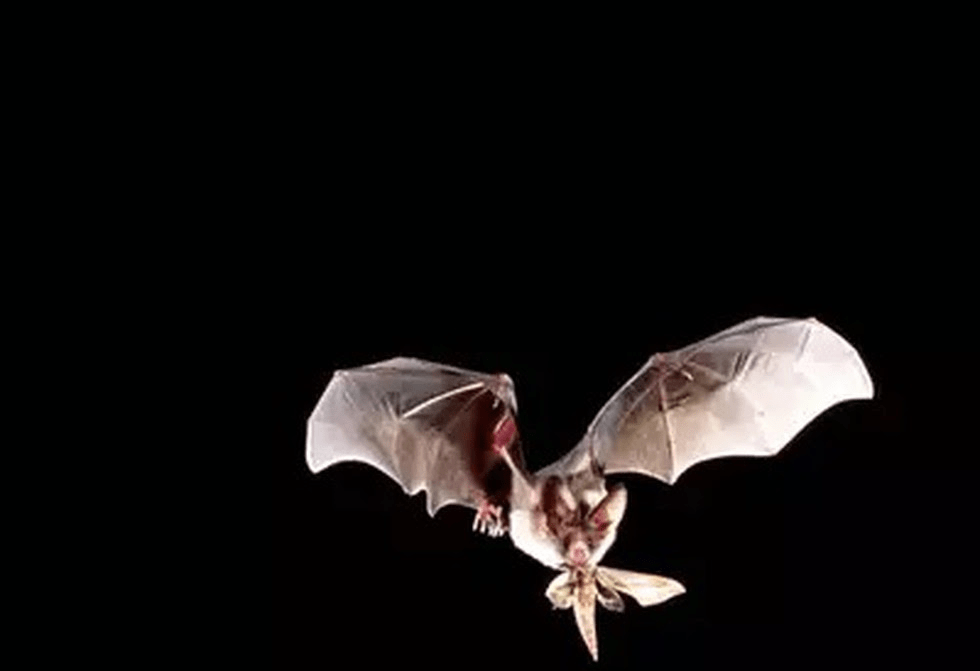
The Karnataka Forest Department, along with the Bat Conservation India Trust (BCIT), is on a war footing to save the Kolar Leaf-Nosed Bat from extinction.
Important value additions
Common Name: Kolar leaf-nosed bat or leafletted leaf-nosed bat.
Scientific Name: Hipposideros hypophyllus.
It is a species of bat in the family Hipposideridae.
Habitat: Its natural habitats are subtropical or tropical dry forests and caves.
It is endemic to India.
It is found only in one cave in Hanumanahalli village in the Kolar district of Karnataka.
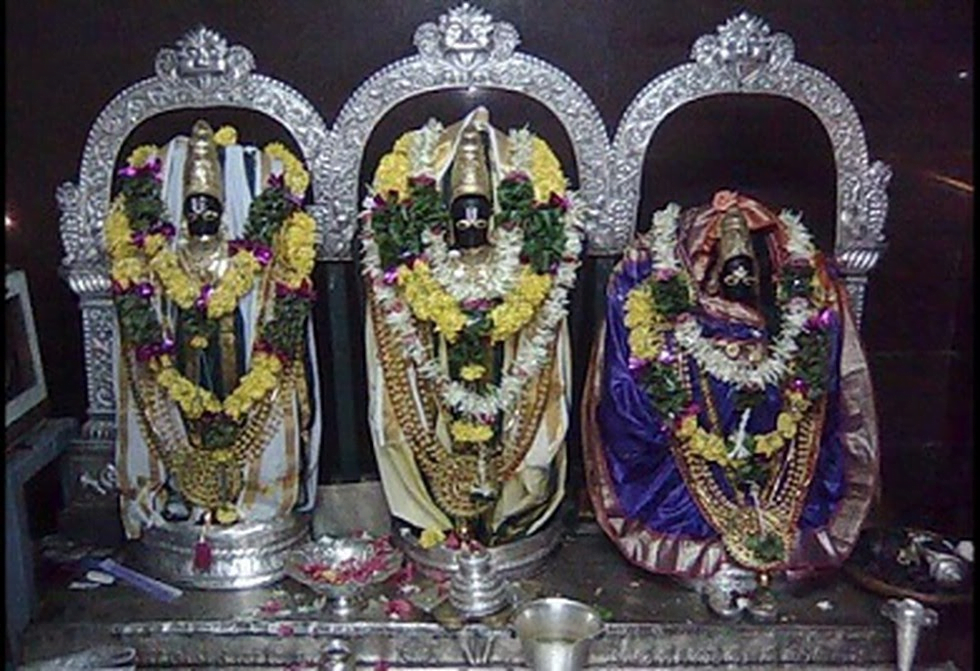
The 16th century Ramateertham temple was recently seen in news due to the vandalism of the idol of Lord Rama at the Kodandarama Swamy temple.
Important value additions
The idol of Lord Rama atop the historic Ramateertham temple, located 12 km from Vizianagaram, was vandalised on December 29.
It is located in Andhra Pradesh.
Ramateertham is one of the places made sacred by a traditional connection with Lord Sree Rama.
The famous ancient temple of Ramachandra Swamy can be found here.
The idols of Lord Ramachandra Swamy, Sita and Lakshmana in Silver kavachas can be seen at this temple.
Miscellaneous
Sabari River
In a unique initiative, Migrant fisher-folk families have built temporary houses on the sands of Sabari river along the tri-State border of Andhra Pradesh, Odisha and Chhattisgarh in East Godavari Agency.
Sabari River is one of the main tributaries of Godavari.
It originates from the western slopes of Eastern Ghats in Odisha from Sinkaram hill ranges.
It forms common boundary between Chhattisgarh and Odisha states and later enters into Andhra Pradesh to merge with River Godavari.
It is also known as Kolab river in Odisha.
Upper Kolab project, located in Odisha across the Sabari is a major dam project supplying water for irrigation and Hydro power generation
Sileru River
Sileru River (known as Machkund in its upper reaches) is the major tributary of Sabari.
It joins Sabari river at tri-junction boundary point of Andhra Pradesh, Chhattisgarh and Odisha.
Sileru river has huge potential of hydro electricity generation.
(Mains Focus)
ECONOMY/ GOVERNANCE
Topic: General Studies 3:
Indian Economy and issues relating to planning, mobilization, of resources, growth, development and employment.
Context: The data on gross non-performing assets (GNPA) has fallen from 11.5% in March 2018 to 7.5% of outstanding loans by September 2020.
What Is a Non-Performing Asset (NPA)?
A nonperforming asset (NPA) refers to a classification for loans or advances that are in default or in arrears.
A loan is in arrears when principal or interest payments are late or missed.
A loan is in default when the lender considers the loan agreement to be broken and the debtor is unable to meet his obligations.
In India, a non performing asset (NPA) is defined as a loan or advance for which the principal or interest payment remained overdue for a period of 90 days
Why NPA resolution is crucial for the economy?
Simply put, banks’ ability to lend is critical for businesses and the economy to grow. A deluge of bad loans (i.e. NPAs) impairs banks’ ability and willingness to lend that furthers impairs the growth prospects of economy.
Improvement of Banking Health in recent quarters
Private Sector Profitable: After losses in two consecutive years, India’s scheduled commercial banks turned profitable in 2019-20.
PSB losses reduced: However, State-run banks continued to bleed for the fifth year in a row, but their losses were much more stifled.
Impact of Policies: The RBI attributed this to the resolution of a few large accounts through the introduction of the Insolvency and Bankruptcy Code (IBC) in 2016, and fresh slippages in loan accounts dipping to just 0.74%.
Genesis of the NPA Problem
Boom years of late 2000s: A large part of the problem started in the latter half of 2010s, as assumptions of persistently high economic growth made several large corporates overzealous in their investment ambitions, thus over-leveraging themselves in the process.
Role of Easy Credit by Banks: On the prospects of high economic growth financial sector, led by public sector banks, fuelled these expansion plans through easy money on credit.
2008 Financial Crisis: Growth (and demand) fizzled out following the global financial crisis of 2008. Despite the fire-fighting measures taken by government, the impact of the global crisis was felt in coming years. The crisis got further precipitated by Policy Paralysis of UPA-2 government (Corruption Scandals, Coalition Politics, standstill bureaucracy)
Vicious cycle: The stress from stretched corporate balance sheets (revenue impacted due to slowdown) infected banks’ own books and underwhelmed banks own capacity for fresh lending. Former Chief Economic Adviser Arvind Subramanian had called it India’s ‘twin balance sheet problem’ in the Economic Survey for 2016-17.
Peak reached in 2018: Over the course of 2014-19, India’s banks were put on high alert by RBI for tighter recognition norms for bad loans. As a result, in March 2018, when bad loans on their books peaked to over ₹10 lakh crore — around 11.5% of all loans.
Policy Measures to stem the problem: The vicious cycle of twin balance sheet problem was interrupted to an extent by the IBC, which, along with tighter recognition norms for bad loans, helped correct the course over time.
COVID-19 should have further worsened NPA problem right?
The reason bad loans and insolvency proceedings have not surged as multiple businesses went kaput, taking millions of employees with outstanding retail loans down with them, is because of steps taken by government
Regulatory forbearance steps taken by authorities: Interest rates were cut after the onset of the pandemic, a moratorium was offered on loan instalments due from borrowers, and liquidity was infused into the system to keep the wheels of the economy moving without a further shock
Suspension of IBC: At the same time, the invocation of the IBC was suspended for loans that went into default on or after March 25, when the lockdown began. While this suspension has now been stretched till March 31, 2021, a loan restructuring window for borrowers was closed in December 2020.
Support to Stressed Sectors: Government under its Atmanirbhar package provided credit flows to some productive and COVID-19-stressed sectors (ex: Production Linked Incentive Scheme)
A decline in bad loans is good news. But is it the real picture?
Economic Slowdown before Pandemic: The problem is that the COVID-19 pandemic and the national lockdown upended businesses and revenue models across industries, just as it did in the rest of the world. But unlike most of its peers, India’s economy had been declining sharply even before the emergence of the virus.
Inadequate Support: Despite all this, life support in the form of adequate credit flows to some productive and COVID-19-stressed sectors has been deficient, the central bank has said.
True Picture will emerge when support measures are rolled back: RBI believes that a real picture of the state of borrowers’ accounts (and consequently, the banking system in general, and the economy at large), will emerge once the policy support measures are rolled back. Had the central bank’s normal loan classification norms been followed instead of the COVID-19 relief measures, bad loans would have been higher, the RBI has argued
Housing Finance Sector may drive NPAs in Future: RBI has also warned about large-scale loan defaults looming over housing finance companies, which have been hit by delays in completion of housing projects, cost overruns due to reverse migration of labourers, and delayed investments by buyers in the affordable housing sector as incomes shrank and jobs were lost.
What measures has RBI recommended to deal with future challenges?
To make the banking sector healthy in the face of large-scale delinquencies and balance-sheet stress that the ravages of the pandemic leave behind, it is critical to
Rewind various relaxations in a timely manner”,
Rein in loan impairment
Ensure adequate capital infusion into banks
Experts say more taxpayer money may be needed to shore up public sector banks.
Conclusion
For now, as the central bank has said, the restoration of the health of banking and non-banking financial sectors depends on the revival of the real economy and how quickly the animal spirits of entrepreneurship return.
The Union Budget for 2021-22, which is now just four weeks away, would be critical for banks on two fronts – in what it does to revive demand and investments, and how much money it can promise to set aside for recapitalising public sector banks in the coming year.
Conclusion
Atmanirbhar Package
N.K.Singh Panel on FRBM Act
AGRICULTURE / GOVERNANCE/ FEDERALISM
Topic: General Studies 2,3:
Public Distribution System- objectives, functioning, limitations, revamping; issues of buffer stocks and food security
Government policies and interventions for development in various sectors and issues arising out of their design and implementation.
Context: Ongoing farmer protests while the government argues that the three farm laws are a logical extension of market reforms into India’s agriculture sector.
Fear of losing Social Safety Net: For the protesting farmers — primarily belonging to Punjab and Haryana — there is a fear that new farm laws and allegations of dilution of MSP system will rob farmers of their traditional social safety net.
Farming is viewed as fall back option: Farmers do not view farming merely as a “job” as many of us who are part of the modern economy often do. For them, farming is also the fall-back option when other ventures fail.
Farming as only livelihood Option: For farmers, cultivation is not just about productivity metrics; it is also about an option for them to eke out a living, however meagre, when they find themselves unable to participate in the other sectors of the economy — industries and services sectors.
This perhaps explains why two-thirds of the world’s second-most populous country lives in rural areas. Or why agriculture employs almost half of India (44%) despite contributing less than 15% to India’s GDP.
Does the Indian government support its farmers as much as some of the other comparable countries?
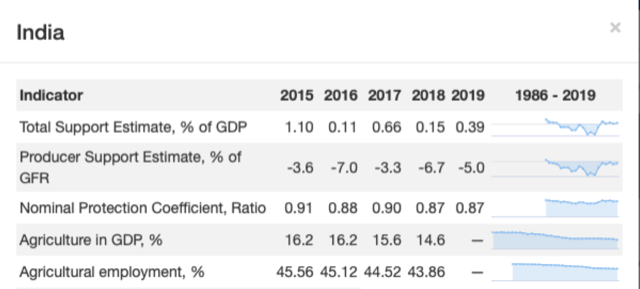
According to the data provided by Organisation for Economic Co-operation and Development (or OECD), the Indian farmers seem to have a genuine grouse.
Across countries, the OECD provides five sets of data on the issue of agriculture support and India trails on most counts.
Producer Support Estimates or PSEs
These are transfers to agricultural producers and are measured at the farm gate level.
They comprise market price support, budgetary payments and the cost of revenue foregone.
Support to producers in India is composed of budgetary spending corresponding to 7.8% of gross farm receipts, positive market price support (MPS) of +2.0% of gross farm receipts among those commodities which are supported, and negative market price support of -14.8% among those which are implicitly taxed.
Overall, this leads to negative net support of -5.0% of gross farm receipts (%PSE or producer support estimate) in 2019
PSEs for USA was approx. +10% and EU was +20% .
Consumer Support Estimates or CSE
These refer to transfers from consumers of agricultural commodities.
They are measured at the farm gate level. “If negative, the CSE measures the burden (implicit tax) on consumers through market price support (higher prices), that more than offsets consumer subsidies that lower prices to consumers,
India’s CSE as a percentage of agricultural consumption, 2019 is at around 24%, while that of US, EU is at around +10% and -3% respectively.
General services support (or GSSE)
GSSE transfers are linked to measures creating enabling conditions for the primary agricultural sector through development of private or public services, institutions and infrastructure.
GSSE includes policies where primary agriculture is the main beneficiary, but does not include any payments to individual producers. GSSE transfers do not directly alter producer receipts or costs or consumption expenditure
India’s GSSE, in Million US Dollars 2019, was at around 17k, while that of USA, EU and China was at around 10K, 12K and 35K respectively.
Total Support Estimate (or TSE)
The TSE transfers represent the total support granted to the agricultural sector, and consists of producer support (PSE), consumer support (CSE) and general services support (GSSE).
India’s TSE, measured as a percentage of GDP, in 2019 was nearly at 0.4%, while that of EU, China and Indonesia was at nearly 0.6%, 1.5% and 3% respectively.
Producer protection
The PP is the ratio between the average price received by producers (measured at the farm gate), including net payments per unit of current output, and the border price (measured at the farm gate).
For instance, a coefficient of 1.10, which China has, suggests that farmers, overall, received prices that were 10% above international market levels.
Conclusion
The negative value of the PSE reflects that domestic producers, overall, continue to be implicitly taxed, as budgetary payments to farmers do not offset the price-depressing effect of complex domestic regulations and trade policy measures.
Mirroring the farm price-depressing effect on producers, the policies provide implicit support to consumers.
In other words, contrary to the perception among many, the government has preferred the welfare of Indian consumers over the Indian farmers.
(TEST YOUR KNOWLEDGE)
Model questions: (You can now post your answers in comment section)
Note:
Correct answers of today’s questions will be provided in next day’s DNA section. Kindly refer to it and update your answers.
Comments Up-voted by IASbaba are also the “correct answers”.
Q.1Consider the following statements regarding National Biopharma Mission (NBM):
It is implemented byBiotechnology Industry Research Assistance Council (BIRAC).
It is 50% co-funded by AIDB.
Which of the above is or are correct?
1 only
2 only
Both 1 and 2
Neither 1 nor 2
Q.2 Which of the following is/are India’s operational research stations in Antarctica?
Dakshin Gangotri
Maitri
Bharati.
Both (a) and (b)
Q.3 Consider the following statements regarding Kolar leaf-nosed bat :
It is found only in one cave of Andhra Pradesh.
It is listed as critically endangered in IUCN Red List.
Which of the above is or are correct?
1 only
2 only
Both 1 and 2
Neither 1 nor 2
Q.4 Which of the following is not the Ramsar Site of Northeast India?
Loktak Lake
Rudrasagar Lake
Deepor Beel
Kabartal Wetland
ANSWERS FOR 4th January 2021 TEST YOUR KNOWLEDGE (TYK)