In his address to the nation, PM Modi observed that –
Country should view the Covid-19 crisis as an opportunity to achieve economic self-reliance.
He stressed on the importance of promoting “local” products.
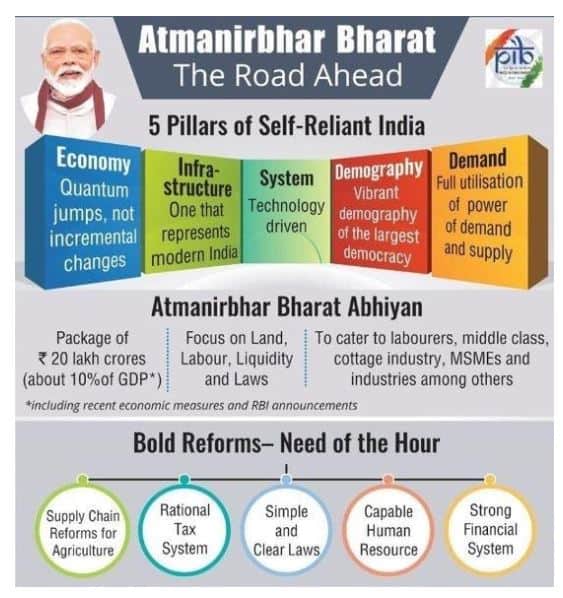
He called it Atmanirbhar Bharat Abhiyan (or Self-reliant India Mission)
Indian government announced a special economic package — worth Rs 20 lakh crore or 10% of India’s GDP in 2019-20 — aimed towards achieving this mission.
It includes the measures earlier announced by the finance ministry and steps taken by the Reserve Bank of India.
5 pillars
According to the PM a self-reliant India should stand on 5 pillars –
Economy
Infrastructure
21st century technology driven arrangements and system
Demand
Vibrant Demography
About the package:
As mentioned above, it is worth Rs 20 lakh crore or 10% of India’s GDP in 2019-20 — which is aimed towards achieving economic self-reliance.
The package will focus on land, labour, liquidity and laws.
It will cater to various sections including cottage industry, MSMEs, labourers, middle class, industries, among others.
The package will also focus on empowering the poor, labourers, migrants, etc., both from organized and unorganized sectors.
Reforms needed for achieving economic self-reliance
Several bold reforms are needed to make the country self-reliant, so that the impact of crisis such as COVID, can be negated in future.
These reforms include –
supply chain reforms for agriculture,
rational tax system,
simple and clear laws,
capable human resource and
a strong financial system.
These reforms are expected to promote business, attract investment, and further strengthen Make in India.
Also for India to be truly self-reliant and self-confident, public investment in education, human capability and research and development has to increase.
‘Coronavirus stimulus packages’
The US has committed to the largest rescue package by any country in pure dollar terms of USD 2.7 trillion but as percentage of GDP it trails behind Japan. The US measures work out at an estimated 13 per cent of GDP.
Japan has announced a package equivalent to 21.1 per cent of its GDP. It has outlined USD 1.1 trillion recovery package and plans for further spending.
Sweden – stimulus equal to 12 per cent of its GDP and Australia (10.8 per cent).
Germany has announced a spending of around USD 815 billion, equal to 10.7 per cent of its GDP.
Connecting the dots:
Highlight the measures announced by the current government to help boost the economy during the COVID-19 crisis.
(TEST YOUR KNOWLEDGE)
Model questions: (You can now post your answers in comment section)
Note:
Correct answers of today’s questions will be provided in next day’s DNA section. Kindly refer to it and update your answers.
Comments Up-voted by IASbaba are also the “correct answers”.
Q.1 Which of the following is the basic aim of the Atma-Nirbhar Bharat Abhiyan?
To make India self-reliant
To increase FDI in the country
To increase the export capacity of the country
To enhance the quality of educational institutes
Q.2 With regard to Atma-Nirbhar Bharat Abhiyan, consider the following statements:
The package would connstitute 10% of India’s GDP.
It is based upon three pillars – infrastructure, economy and innovation
Which of the above is/are correct?
1 only
2 only
Both 1 and 2
Neither 1 nor 2
Q.3 With regard to the recent package announced for MSMEs, consider the following:
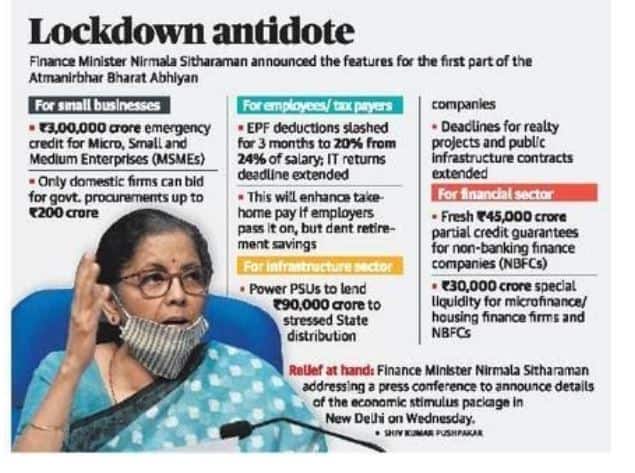
₹3 lakh crore collateral free loan scheme for businesses, especially MSMEs.
A ₹50 crore equity infusion through an MSME fund of funds.
Which of the above is/are correct?
1 only
2 only
Both 1 and 2
Neither 1 nor 2
Q.4 Consider the following statements with regard to the recent announcements made under Atma nirbhar Bharat Abhiyan:
EPF contributions have been reduced from 12 % to 10%.
EPF provided to low-income organised workers under the PMGKY will be extended for another 5 months.
Which of the above is/are correct?
1 only
2 only
Both 1 and 2
Neither 1 nor 2
ANSWERS FOR 13th May 2020 TEST YOUR KNOWLEDGE (TYK)