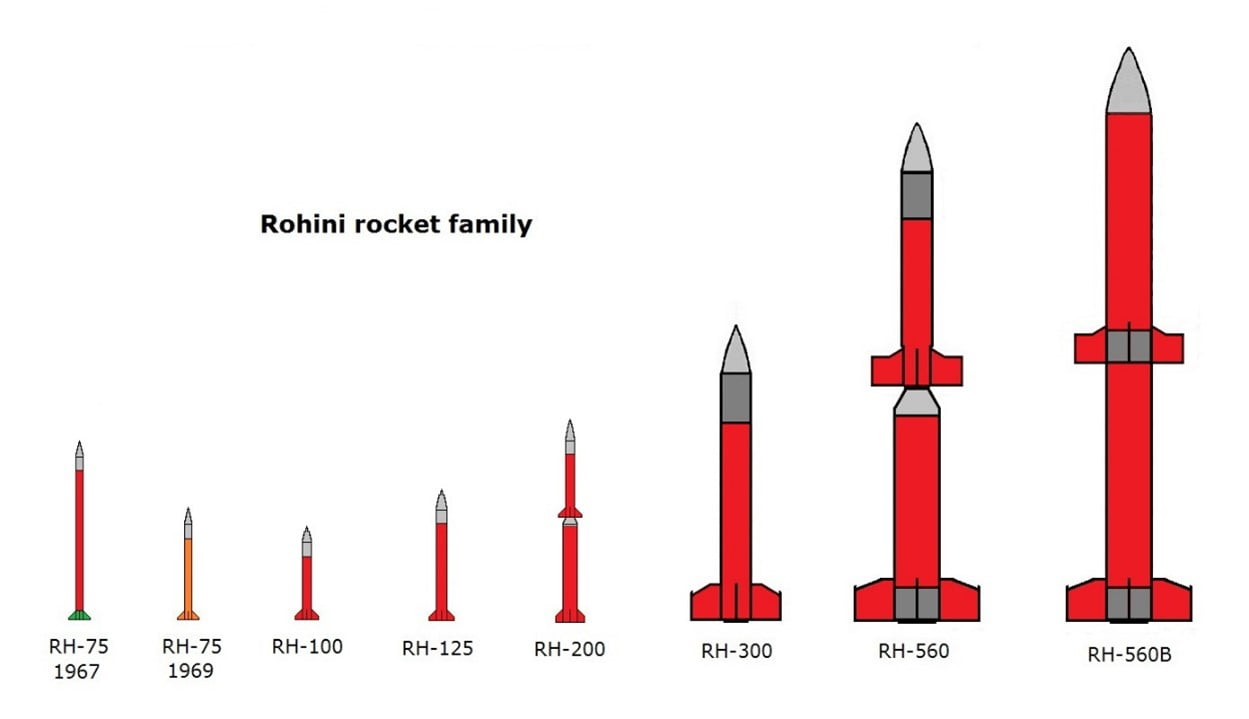
In News: The Indian Space Research Organisation (ISRO) hopes to achieve a remarkable feat — the 200th successful launch of the Rohini RH-200 sounding rocket in a row.
It has completed 198 consecutive successful flights and the 199th and 200th launch are planned to take place during 2022.
ISRO has launched more than 1,600 RH-200 rockets so far. The 100th consecutive successful mission happened in 2015.
About the rocket:
Sounding rockets are one or two stage solid propellant rockets used for probing theupper atmospheric regions and for space research developed the ISRO.
RH-200 is a 3.5-metre-tall two-stage rocket capable of climbing to a height of 70 km bearing scientific payloads.
The first and second stages of RH-200 are powered by solid motors.
The ‘200’ in the name denotes the diameter of the rocket in mm.
Other operational Rohini variants are RH-300 Mk-II and RH-560 Mk-III.
The first RH-200 to use a new propellant based on hydroxyl-terminated Polybutadiene (HTPB) was successfully flown in 2020, while the previous versions had used a polyvinyl chloride (PVC)-based propellant.
About sounding rockets:
Sounding rockets have been used for a variety of experiments, including those on phenomena related to eclipses.
The first sounding rocket was the American Nike-Apache – launched in 1963.
The ISRO launched its own version – Rohini RH-75 – in 1967.
The sounding rocket programme was the bedrock on which the edifice of launch vehicle technology was built.
Today, these small rockets are launched both from the Thumba Equatorial Rocket Launching Station (TERLS) and the Satish Dhawan Space Centre, Sriharikota.