In News: Recently Govt’s FY19 health spending dropped
About the Issue as per National Health Accounts Estimates 2018-19:
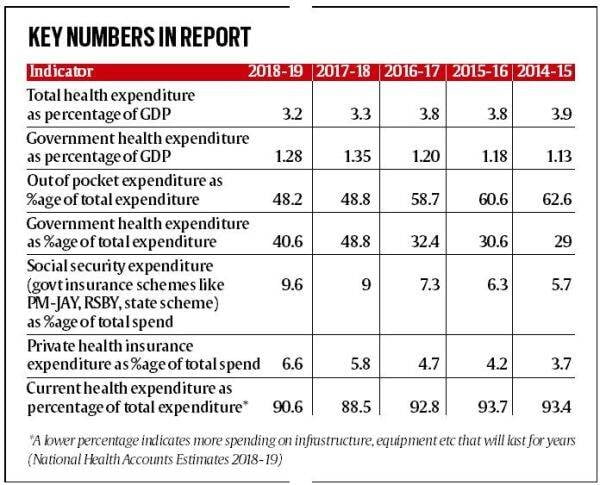
Government spending on health as a proportion of total health expenditure has increased by more than 11% over the previous five years, from 23.2% in 2013-14 to 34.5% in 2018-19.
Government spending as proportion ofGDP went down to 1.28% from 1.35% in the previous year’s (2017-18) report.
Overall expenditure on health has declined. The total health spending — (both government and non-government agents) — went down from 3.9% of the GDP to 3.2% in the five years up to 2018-19.
Out-of-pocket health spending is lower at point of care, but people are still spending more than the government
About Out-of-pocket expenditure (OOPE) as per NSSO data:
Since healthcare services in the country being largely provided by private players; hence, out-of-pocket spending becomes important
OOPE
Down
48.2% of the total health expenses in the year 2018-19
2.87 lakh crore, which was equivalent to 1.52% of the GDP for the year
Implying – people spent much more than the government
48.8% in the previous year (2017-18)
62.6% recorded in 2014-15
Comparisonwith other countries in the region as per Global Health Expenditure Database
In 2017, India – 66thposition (out of 189 countries) with $100.05 per capita OOPE
Bhutan was at 37th, Bangladesh at 52nd, Pakistan at 55th
Highestin the developedcountries
Switzerland 189th
United States ranking 185th
United Kingdom 167th
Causes
fewer people are seeking care, which is counter-intuitive considering health related distress are rising
data collection is such that it does not capture the spending by the richest 5% of the country, thereby leaving out a big chunk of out-of-pocket expenditure from the estimates.
About Current health expenditure:
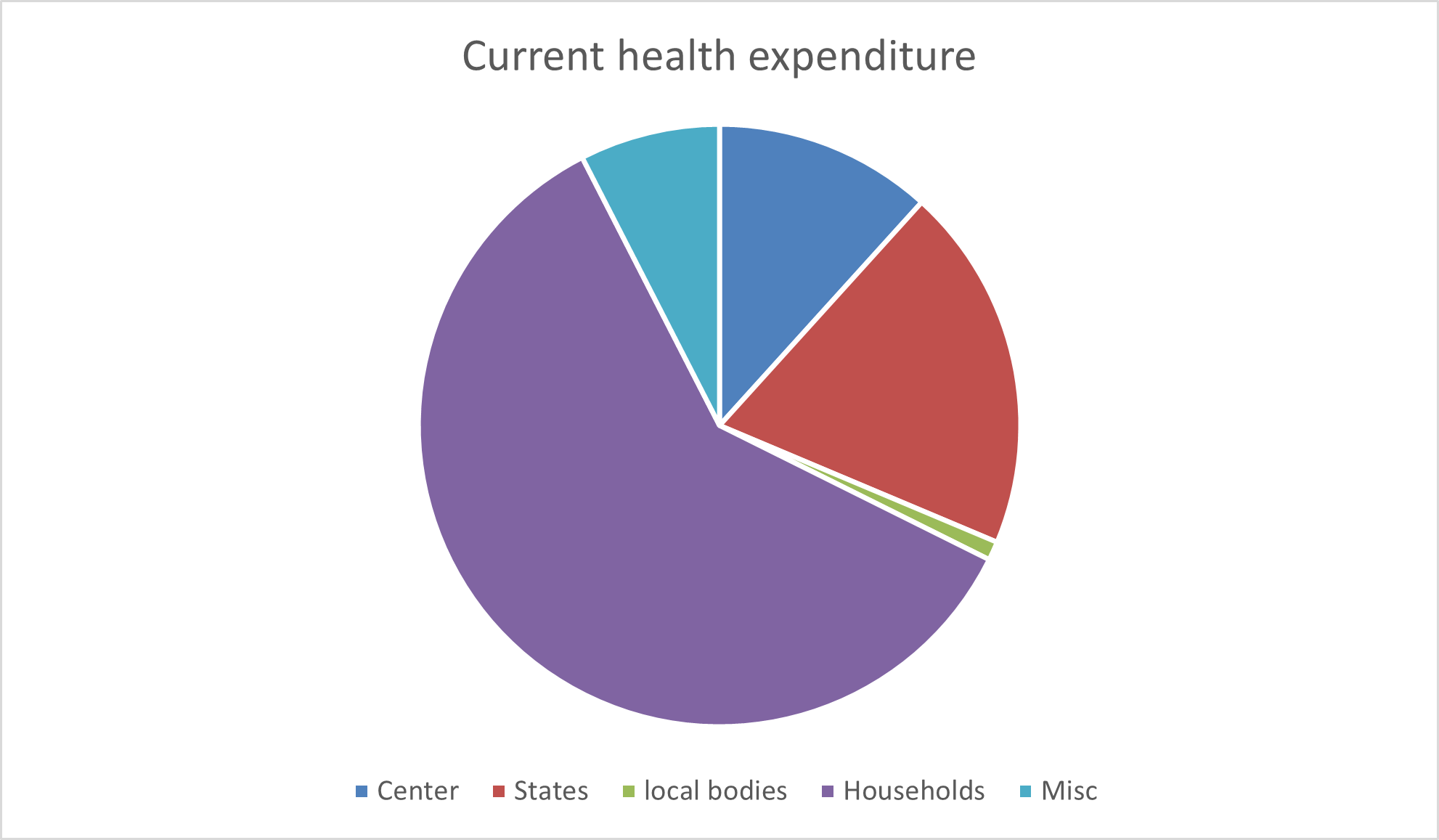
Centre’s share = 11.71%, state governments = 19.63%, local bodies 1.01%, and households (including insurance contributions) = 60.11% corporates (as insurance contributions), NGOs, and external or donor funding.
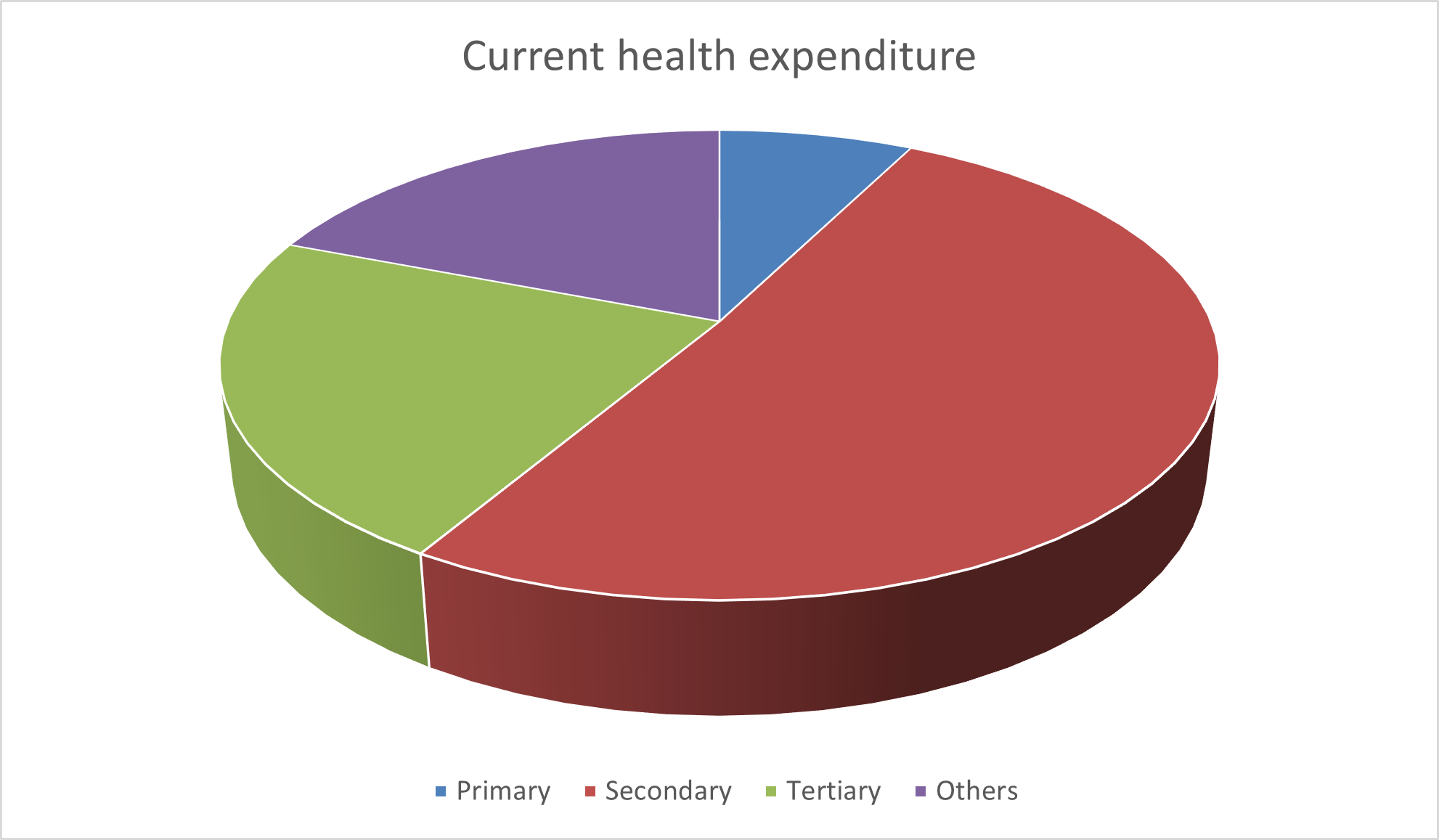
Primary care was 47.4%, secondary care 31.7%, and tertiary care 14.9%. The rest was utilised for governance and supervision, and ‘others.
Causes
Using a wrong indicator that is internationally not comparable. The comparable indicator would be the current health expenditure, which does not include the capital spending on, say, building or equipment that will be used over multiple years
Miscellaneous
OOPE Includes cost-sharing, self-medication and other expenditure paid directly by private households
Issues with Health Sector
Lack of Primary Healthcare Services: The existing public primary health care model in the country is limited in scope.
Even where there is a well-functioning public primary health centre, only services related to pregnancy care, limited childcare and certain services related to national health programmes are provided.
Supply-Side Deficiencies:Poor health management skills and lack of appropriate training and supportive supervision for health workers prevent delivery of the desired quality of health services.
Inadequate Funding: India spent 1.8% of its GDP on health in FY 2020-21 and 1-1.5% in the previous years. India’s total out-of-pocket expenditure is around 2.3 % of GDP.
As compared with the OECD countries’ average of 7.6% and other BRICS countries’ average of 3.6% on their health sector, this is considerably low.
Overlapping Jurisdiction: There is no single authority responsible for public health that is legally empowered to issue guidelines and enforce compliance of the health standards
Less than Required Doctors:
India currently has one doctor over the population of 1,445 against the WHO norm of 1:1000.
Government’s scheme on healthcare
Ayushman Bharat Yojana
PM-JAY
National Rural health mission
PM Swasth suraksha yojana
Intensified Mission Indradhanush 3.0
Way Forward
To reduce costs outside a few islands of excellence, such as AIIMS, investments in other medical colleges should be promoted in order to potentially reduce costs and improve healthcare quality.
Emphasising on Public Private Partnerships (PPP), leveraging private sector expertise in achieving targets.
Incentivising R&D by additional tax deductions to further support greater investments in new drug developments.
To prepare the existing healthcare workforce to provide the people the proposed healthcare facilities, it is important to give significant attention to their training, re-skilling, and knowledge upgradation.