Hello Friends
The 60 Days Rapid Revision (RaRe) Series is IASbaba’s Flagship Initiative recommended by Toppers and loved by the aspirants’ community every year.
It is the most comprehensive program which will help you complete the syllabus, revise and practice tests on a daily basis. The Programme on a daily basis includes
Daily Prelims MCQs from Static (Monday – Saturday)
Daily Current Affairs MCQs (Monday – Saturday)
Daily CSAT Quiz (Monday – Friday)
Note – Daily Test of 20 static questions, 10 current affairs, and 5 CSAT questions. (35 Prelims Questions) in QUIZ FORMAT will be updated on a daily basis.
To Know More about 60 Days Rapid Revision (RaRe) Series – CLICK HERE
60 Day Rapid Revision (RaRe) Series Schedule – CLICK HERE
0 of 35 questions completed
Questions:
The following Test is based on the syllabus of 60 Days Plan-2023 for UPSC IAS Prelims 2022.
To view Solutions, follow these instructions:
You have already completed the test before. Hence you can not start it again.
Test is loading...
You must sign in or sign up to start the test.
You have to finish following test, to start this test:
0 of 35 questions answered correctly
Your time:
Time has elapsed
You have scored 0 points out of 0 points, (0)
| Average score |
|
| Your score |
|
| Pos. | Name | Entered on | Points | Result |
|---|---|---|---|---|
| Table is loading | ||||
| No data available | ||||
‘Alphafold’ is a revolutionary artificial-intelligence (AI) network which can predict:
Solution (d)
Researchers have used AlphaFold — the revolutionary artificial intelligence (AI) network — to predict the structures of more than 200 million proteins from some 1 million species, covering almost every known protein on the planet.
The data dump is freely available on a database set up by DeepMind, the London-based AI company, owned by Google, that developed AlphaFold, and the European Molecular Biology Laboratory’s European Bioinformatics Institute (EMBL–EBI), an intergovernmental organization near Cambridge, UK.
Solution (d)
Researchers have used AlphaFold — the revolutionary artificial intelligence (AI) network — to predict the structures of more than 200 million proteins from some 1 million species, covering almost every known protein on the planet.
The data dump is freely available on a database set up by DeepMind, the London-based AI company, owned by Google, that developed AlphaFold, and the European Molecular Biology Laboratory’s European Bioinformatics Institute (EMBL–EBI), an intergovernmental organization near Cambridge, UK.
‘Nano Copper’ has been in the news in the context of:
Solution (b)
A new copper coating that kills bacteria quicker and in greater amounts than current formulations could soon be available for hospitals and other high-traffic facilities. A team of UBC researchers have designed a Nano-copper coating that includes bacteria-killing Nano scale features and zinc. The Nano scale features are tiny bumps that can kill bacteria by rupturing their cell wall. Zinc, which is also antibacterial, selectively oxidizes in the presence of copper and helps kill bacteria more quickly compared to pure copper alone.
Solution (b)
A new copper coating that kills bacteria quicker and in greater amounts than current formulations could soon be available for hospitals and other high-traffic facilities. A team of UBC researchers have designed a Nano-copper coating that includes bacteria-killing Nano scale features and zinc. The Nano scale features are tiny bumps that can kill bacteria by rupturing their cell wall. Zinc, which is also antibacterial, selectively oxidizes in the presence of copper and helps kill bacteria more quickly compared to pure copper alone.
Consider the following statements:
How many of the above statements are correct?
Solution (c)
| Statement 1 | Statement 2 | Statement 3 |
| Correct | Correct | Correct |
| Machine learning is the concept that a computer program can learn and adapt to new data without human intervention. Machine learning is a field of artificial intelligence (AI) that keeps a computer’s built-in algorithms current regardless of changes in the worldwide economy. Hence, statement 1 is correct. | Artificial intelligence (AI) refers to the simulation of human intelligence in machines that are programmed to think like humans and mimic their actions. The term may also be applied to any machine that exhibits traits associated with a human mind such as learning and problem-solving. Hence, statement 2 is correct. | Natural language processing (NLP) refers to the branch of computer science—and more specifically, the branch of artificial intelligence or AI—concerned with giving computers the ability to understand text and spoken words in much the same way human beings can. Hence, statement 3 is correct. |
Solution (c)
| Statement 1 | Statement 2 | Statement 3 |
| Correct | Correct | Correct |
| Machine learning is the concept that a computer program can learn and adapt to new data without human intervention. Machine learning is a field of artificial intelligence (AI) that keeps a computer’s built-in algorithms current regardless of changes in the worldwide economy. Hence, statement 1 is correct. | Artificial intelligence (AI) refers to the simulation of human intelligence in machines that are programmed to think like humans and mimic their actions. The term may also be applied to any machine that exhibits traits associated with a human mind such as learning and problem-solving. Hence, statement 2 is correct. | Natural language processing (NLP) refers to the branch of computer science—and more specifically, the branch of artificial intelligence or AI—concerned with giving computers the ability to understand text and spoken words in much the same way human beings can. Hence, statement 3 is correct. |
In the context of Robotics, consider the following statements
Choose the correct code:
Solution (d)
| Statement 1 | Statement 2 |
| Incorrect | Incorrect |
| Tele-robot is the science of constructing semi-autonomous robots controlled from a distance, chiefly using a wireless network.
It is a combination of two major subfields, teleoperation and telepresence. Teleoperation meaning the operation of a machine at a distance whereas telepresence means a set of technologies that allow a person to feel as if they were present, to give the appearance of being present. |
Bionics is the science of constructing artificial systems that have some of the characteristics of living systems.
These are used to apply the way animals move to the design of robots. |
Solution (d)
| Statement 1 | Statement 2 |
| Incorrect | Incorrect |
| Tele-robot is the science of constructing semi-autonomous robots controlled from a distance, chiefly using a wireless network.
It is a combination of two major subfields, teleoperation and telepresence. Teleoperation meaning the operation of a machine at a distance whereas telepresence means a set of technologies that allow a person to feel as if they were present, to give the appearance of being present. |
Bionics is the science of constructing artificial systems that have some of the characteristics of living systems.
These are used to apply the way animals move to the design of robots. |
Consider the following statements
Choose the incorrect code:
Solution (a)
| Statement 1 | Statement 2 |
| Correct | Incorrect |
| India’s Artificial Intelligence strategy is known as “AI for All” which t focuses on responsible AI, building AI solutions at scale with an intent to make India the AI garage of the world which means a trusted nation to which the world can outsource AI-related work. It emphasizes on inclusive development through the use of AI technologies. | India is a part of the Global Partnership on Artificial Intelligence (GPAI). It is an international and multi-stakeholder initiative to guide the responsible development and use of AI, grounded in human rights, inclusion, diversity, innovation, and economic growth. It aims to bridge the gap between the theory and practice of AI. |
Solution (a)
| Statement 1 | Statement 2 |
| Correct | Incorrect |
| India’s Artificial Intelligence strategy is known as “AI for All” which t focuses on responsible AI, building AI solutions at scale with an intent to make India the AI garage of the world which means a trusted nation to which the world can outsource AI-related work. It emphasizes on inclusive development through the use of AI technologies. | India is a part of the Global Partnership on Artificial Intelligence (GPAI). It is an international and multi-stakeholder initiative to guide the responsible development and use of AI, grounded in human rights, inclusion, diversity, innovation, and economic growth. It aims to bridge the gap between the theory and practice of AI. |
With reference to the turing test, consider the following statements
Choose the correct code:
Solution (c)
| Statement 1 | Statement 2 |
| Correct | Correct |
| The turing test is a test to determine whether machines can impersonate human beings.
It is a simple method of determ0ining whether a machine can demonstrate human intelligence. |
It is a method of inquiry in artificial intelligence (AI) for determining whether or not a computer is capable of thinking like a human being. The test is named after Alan Turing, the founder of the Turing Test and an English computer scientist, cryptanalyst, mathematician and theoretical biologist. |
Solution (c)
| Statement 1 | Statement 2 |
| Correct | Correct |
| The turing test is a test to determine whether machines can impersonate human beings.
It is a simple method of determ0ining whether a machine can demonstrate human intelligence. |
It is a method of inquiry in artificial intelligence (AI) for determining whether or not a computer is capable of thinking like a human being. The test is named after Alan Turing, the founder of the Turing Test and an English computer scientist, cryptanalyst, mathematician and theoretical biologist. |
Consider the following statements
Which of the statements given above is/are correct?
Solution (b)
| Statement 1 | Statement 2 |
| Incorrect | Correct |
| The Language Model for Dialogue Applications (LaMDA) is a Google’s artificial intelligence-based chatbot.
LaMDA can engage in a free-flowing way about a seemingly endless number of topics, an ability that the company thinks can unlock more natural ways of interacting with technology and the entirely new categories of helpful applications. LaMDA 2.0 will possibly take an idea and generate imaginative and relevant descriptions, can stay on a particular topic even if a user strays off-topic, and can also suggest a list of things that are needed for a specified activity. |
The Chatbots is a form of Artificial Intelligence (AI) used in messaging apps.
This tool helps add convenience for customers—they are automated programs that interact with customers like a human would and cost little to nothing to engage with. Key example – Amazon’s Alexa.
|
Solution (b)
| Statement 1 | Statement 2 |
| Incorrect | Correct |
| The Language Model for Dialogue Applications (LaMDA) is a Google’s artificial intelligence-based chatbot.
LaMDA can engage in a free-flowing way about a seemingly endless number of topics, an ability that the company thinks can unlock more natural ways of interacting with technology and the entirely new categories of helpful applications. LaMDA 2.0 will possibly take an idea and generate imaginative and relevant descriptions, can stay on a particular topic even if a user strays off-topic, and can also suggest a list of things that are needed for a specified activity. |
The Chatbots is a form of Artificial Intelligence (AI) used in messaging apps.
This tool helps add convenience for customers—they are automated programs that interact with customers like a human would and cost little to nothing to engage with. Key example – Amazon’s Alexa.
|
Consider the following statements
Choose the correct code:
Solution (c)
| Statement 1 | Statement 2 |
| Correct | Correct |
| Gold Nano Particles (GNPs) are used in the photovoltaic cell manufacturing industry due to greater solar radiation absorbing ability than the conventional bulk gold. GNPs are melted at much lower temperatures (300 °C) than bulk gold (1064 °C). | Cordy Gold Nanoparticles (Cor-AuNPs) is used for drug delivery in the human body.
They are derived from the synthesis of the extracts of Cordyceps Mlitaris and Gold Salts. Cordyceps militaris is a high value parasitic fungus, lab-grown at the Department of Biotechnology’s Technology Incubation Centre (TIC) in Bodoland University. Wild Cordyceps mushroom are found in the eastern Himalayan belt. Gold salts are ionic chemical compounds of gold generally used in medicine. |
Solution (c)
| Statement 1 | Statement 2 |
| Correct | Correct |
| Gold Nano Particles (GNPs) are used in the photovoltaic cell manufacturing industry due to greater solar radiation absorbing ability than the conventional bulk gold. GNPs are melted at much lower temperatures (300 °C) than bulk gold (1064 °C). | Cordy Gold Nanoparticles (Cor-AuNPs) is used for drug delivery in the human body.
They are derived from the synthesis of the extracts of Cordyceps Mlitaris and Gold Salts. Cordyceps militaris is a high value parasitic fungus, lab-grown at the Department of Biotechnology’s Technology Incubation Centre (TIC) in Bodoland University. Wild Cordyceps mushroom are found in the eastern Himalayan belt. Gold salts are ionic chemical compounds of gold generally used in medicine. |
Consider the following statements
Choose the correct code:
Solution (c)
| Statement 1 | Statement 2 |
| Correct | Correct |
| The AI chips are built with specific architecture and have integrated AI acceleration to support deep learning-based applications.
It combines a series of computer commands or algorithms that stimulate activity and brain structure.
|
The Active Neural Network (ANN) is a subset of machine learning.
It is also known as the Deep Neural Network (DNN) comes under the broader umbrella of AI. DNNs go through a training phase, learning new capabilities from existing data. DNNs can then inference, by applying these capabilities learned during deep learning training to make predictions against previously unseen data. Deep learning can make the process of collecting, analysing, and interpreting enormous amounts of data faster and easier. |
Solution (c)
| Statement 1 | Statement 2 |
| Correct | Correct |
| The AI chips are built with specific architecture and have integrated AI acceleration to support deep learning-based applications.
It combines a series of computer commands or algorithms that stimulate activity and brain structure.
|
The Active Neural Network (ANN) is a subset of machine learning.
It is also known as the Deep Neural Network (DNN) comes under the broader umbrella of AI. DNNs go through a training phase, learning new capabilities from existing data. DNNs can then inference, by applying these capabilities learned during deep learning training to make predictions against previously unseen data. Deep learning can make the process of collecting, analysing, and interpreting enormous amounts of data faster and easier. |
Consider the following statements about the artificial neural network
Choose the correct code:
Solution (a)
| Statement 1 | Statement 2 |
| Correct | Incorrect |
| The artificial neural network is a subset of machine learning which is a computational model based on the functions and structure of biological neural networks. Information that runs through the network affects the structure of the artificial neural network due to the fact that a neural network learns or changes based on the input and output.
It is a vital subset of machine learning that helps computer scientists in their work on complex tasks, such as, strategizing, making predictions, and recognizing trends. It is a computational model that mimics the way nerve cells work in the human brain. It is designed to simulate the way the human brain analyses and processes information. It is not like other machine learning algorithms that crunch numbers or organise data, it is an algorithm that learns from experience and repeated tasks performed by its users. |
It can be used in facial recognition, aerospace healthcare, signature Verification, handwriting analysis, stock market prediction, social media and defence.
|
Solution (a)
| Statement 1 | Statement 2 |
| Correct | Incorrect |
| The artificial neural network is a subset of machine learning which is a computational model based on the functions and structure of biological neural networks. Information that runs through the network affects the structure of the artificial neural network due to the fact that a neural network learns or changes based on the input and output.
It is a vital subset of machine learning that helps computer scientists in their work on complex tasks, such as, strategizing, making predictions, and recognizing trends. It is a computational model that mimics the way nerve cells work in the human brain. It is designed to simulate the way the human brain analyses and processes information. It is not like other machine learning algorithms that crunch numbers or organise data, it is an algorithm that learns from experience and repeated tasks performed by its users. |
It can be used in facial recognition, aerospace healthcare, signature Verification, handwriting analysis, stock market prediction, social media and defence.
|
Consider the following:
Which of the above are examples of Artificial Intelligence?
Solution (d)
Applications of AI in Different Sectors
Hence (d) is the correct answer.
Solution (d)
Applications of AI in Different Sectors
Hence (d) is the correct answer.
The term ‘Nanomicelles’ recently seen in the news is related to-
Solution (b)
Solution (b)
Consider the following statements with reference to properties of nanomaterial:
How many of the above statements are correct?
Solution (c)
| Statement 1 | Statement 2 | Statement 3 |
| Correct | Correct | Correct |
| Nanomaterials are governed by rules of Quantum mechanics.
On size reduction, the surface to volume ratio increases and the rules of Quantum mechanics start controlling the behaviour of particles instead of laws of Newtonian mechanics. |
The chemical reactivity of the substances increases drastically on nano transformation. For example, Aluminium in its
ulk form is stable but it becomes explosive when transformed to nanoparticle. |
In terms of Physical properties, strength of substance increases while the melting point and boiling point would decrease on size reduction.
This is the reason why graphite is soft while graphine becomes strongest material. |
Solution (c)
| Statement 1 | Statement 2 | Statement 3 |
| Correct | Correct | Correct |
| Nanomaterials are governed by rules of Quantum mechanics.
On size reduction, the surface to volume ratio increases and the rules of Quantum mechanics start controlling the behaviour of particles instead of laws of Newtonian mechanics. |
The chemical reactivity of the substances increases drastically on nano transformation. For example, Aluminium in its
ulk form is stable but it becomes explosive when transformed to nanoparticle. |
In terms of Physical properties, strength of substance increases while the melting point and boiling point would decrease on size reduction.
This is the reason why graphite is soft while graphine becomes strongest material. |
Consider the following statements in the context of ‘Nanoparticles’:
Which of the statements given above is/are correct?
Solution (a)
Solution (a)
Consider the following statements regarding Carbon nanotubes:
How many of the above statements are correct?
Solution (c)
Carbon nanotubes (CNTs)
Applications of Carbon nanotubes (CNTs)
Hence all the statements are correct.
Solution (c)
Carbon nanotubes (CNTs)
Applications of Carbon nanotubes (CNTs)
Hence all the statements are correct.
Consider the following statements
Statement-I :
Vyommitra is a half-humanoid being developed by the Indian Space Research Organisation (ISRO).
Statement-II :
Sophia is a social humanoid robot developed by Space X.
Which one of the following is correct in respect of the above statements?
Solution (c)
Humanoid robot with its body shape built to resemble the human body. Vyommitra, a half-humanoid is being developed by the Indian Space Research Organisation (ISRO) for an unmanned space mission later in 2020. Hence, statement 1 is true.
Sophia is a social humanoid robot developed by Hong Kong-based company Hanson Robotics. Sophia was activated on February 14, 2016, and made her first public appearance at South by Southwest Festival (SXSW) in mid-March 2016 in Austin, Texas, United States. Hence, statement 2 is false.
Solution (c)
Humanoid robot with its body shape built to resemble the human body. Vyommitra, a half-humanoid is being developed by the Indian Space Research Organisation (ISRO) for an unmanned space mission later in 2020. Hence, statement 1 is true.
Sophia is a social humanoid robot developed by Hong Kong-based company Hanson Robotics. Sophia was activated on February 14, 2016, and made her first public appearance at South by Southwest Festival (SXSW) in mid-March 2016 in Austin, Texas, United States. Hence, statement 2 is false.
Which of the following statements about ‘Quantum Mechanics’ is incorrect:
Solution (a)
Solution (a)
With reference to Augmented Reality (AR), consider the following statements:
Which of the statements given above is/are correct?
Solution (a)
Augmented Reality (AR) overlays digital content onto real-life environments and objects. AR works by superimposing digital information onto real-world objects to create a 3D experience that allows users to interact with both the physical and digital worlds. Hence, statement 1 is true.
AR content can also be shown on projectors. Hence, statement 2 is false.
Solution (a)
Augmented Reality (AR) overlays digital content onto real-life environments and objects. AR works by superimposing digital information onto real-world objects to create a 3D experience that allows users to interact with both the physical and digital worlds. Hence, statement 1 is true.
AR content can also be shown on projectors. Hence, statement 2 is false.
With reference to Graphene, consider the following statements:
How many of the above statements are incorrect?
Solution (a)
Graphene is a one-atom-thick sheet of carbon atoms arranged in a honeycomb-like pattern. Graphene is considered to be the world’s thinnest, strongest. Hence, statement 1 is true.
It is the most conductive material – of both electricity and heat. Hence, statement 2 is false.
It is 200 times stronger than steel. Hence, statement 3 is true.
Solution (a)
Graphene is a one-atom-thick sheet of carbon atoms arranged in a honeycomb-like pattern. Graphene is considered to be the world’s thinnest, strongest. Hence, statement 1 is true.
It is the most conductive material – of both electricity and heat. Hence, statement 2 is false.
It is 200 times stronger than steel. Hence, statement 3 is true.
Consider the following statements
Statement-I:
Nanochips are used to check plaque in arteries.
Statement-II:
Nanocarriers can be used for eye surgery.
Which one of the following is correct with respect to the above statements?
Solution (b)
Uses of Nanotechnology in Health Care:-
Nanotech detectors for heart attack.
Nanochips to check plaque in arteries. Hence, statement 1 is true.
Nanocarriers for eye surgery, chemotherapy etc. Hence, statement 2 is true.
Solution (b)
Uses of Nanotechnology in Health Care:-
Nanotech detectors for heart attack.
Nanochips to check plaque in arteries. Hence, statement 1 is true.
Nanocarriers for eye surgery, chemotherapy etc. Hence, statement 2 is true.
Consider the following statements about the provisions of the MTP Amendment Act of 2021:
How many of the above statements are correct?
Solution (b)
The provisions of the MTP Amendment Act of 2021:
Solution (b)
The provisions of the MTP Amendment Act of 2021:
Consider the following statements:
Which of the statements given above is/are correct?
Solution (b)
Solution (b)
Consider the following statements:
Which of the statements given above is/are correct?
Solution (b)
Solution (b)
Which of the following parasites causes Lymphatic Filariasis?
Choose the correct code:
Solution (c)
Lymphatic filariasis commonly known as elephantiasis is a neglected tropical disease. It occurs when filarial parasites are transmitted to humans through mosquitoes. It involves asymptomatic, acute, and chronic conditions. In chronic conditions, it leads to lymphoedema (tissue swelling) or elephantiasis (skin/tissue thickening) of limbs and hydrocele (scrotal swelling). It is caused by infection with parasites classified as nematodes (roundworms) of the family Filariodidea. There are 3 types of these thread-like filarial worms:
Hence option c is correct.
Solution (c)
Lymphatic filariasis commonly known as elephantiasis is a neglected tropical disease. It occurs when filarial parasites are transmitted to humans through mosquitoes. It involves asymptomatic, acute, and chronic conditions. In chronic conditions, it leads to lymphoedema (tissue swelling) or elephantiasis (skin/tissue thickening) of limbs and hydrocele (scrotal swelling). It is caused by infection with parasites classified as nematodes (roundworms) of the family Filariodidea. There are 3 types of these thread-like filarial worms:
Hence option c is correct.
Which of the following reports were released during the sixth assembly of the International Solar Alliance?
How many of the above statements are correct?
Solution (c)
The following reports are released during the sixth assembly of the International Solar Alliance:
Hence option c is correct.
Solution (c)
The following reports are released during the sixth assembly of the International Solar Alliance:
Hence option c is correct.
Consider the following statements:
Which of the statements given above is/are correct?
Solution (b)
Solution (b)
Which of the following pollutants are covered by the Air Quality Index (AQI)?
Choose the correct code:
Solution (d)
Solution (d)
Consider the following:
| Venus Mission | Country |
|
China |
|
United States |
|
India |
|
Europe |
Which of the given pairs are correctly matched?
Solution (c)
| Venus Mission | Country |
| 1. Akatsuki | Japan |
| 2. VERITAS
3. Mariner series 4. Pioneer Venus 1 and Pioneer Venus 2 5. Magellan |
United States |
| 6. Shukrayaan I | India |
| 7. EnVision
8. Venus Express |
Europe |
Hence option c is correct.
Solution (c)
| Venus Mission | Country |
| 1. Akatsuki | Japan |
| 2. VERITAS
3. Mariner series 4. Pioneer Venus 1 and Pioneer Venus 2 5. Magellan |
United States |
| 6. Shukrayaan I | India |
| 7. EnVision
8. Venus Express |
Europe |
Hence option c is correct.
Consider the following statements about Shri Ambaji Mata Temple:
Which of the statements given above is/are correct?
Solution (b)
Solution (b)
Which of the following countries shares a land border with Oman?
Choose the correct code:
Solution (b)
Oman shares a land border with Saudi Arabia, the United Arab Emirates, and Yemen while sharing maritime borders with Iran and Pakistan. The capital and largest city is Muscat. Hence option b is correct.
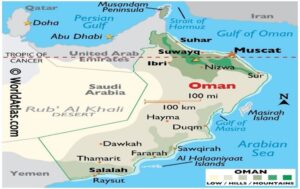
Image Source: World Atlas
Solution (b)
Oman shares a land border with Saudi Arabia, the United Arab Emirates, and Yemen while sharing maritime borders with Iran and Pakistan. The capital and largest city is Muscat. Hence option b is correct.
Image Source: World Atlas
If 12 + 22 + 32 + …….. + 102 + 112 + 122 = 650, then 5 + 20 + 45 + ….. + 500 + 605 + 720 will be equal to
Solution (c)
12 + 22 + 32 + …….. + 102 + 112 + 122 = 650
According to the question, we have to find out:
5 + 20 + 45 + …… + 500 + 605 + 720
5(1 + 4 + 9 + …… + 100 + 121 = 144)
5 (12 + 22 + 32 +……+ 102 + 112 + 122)
5*650
3250
Solution (c)
12 + 22 + 32 + …….. + 102 + 112 + 122 = 650
According to the question, we have to find out:
5 + 20 + 45 + …… + 500 + 605 + 720
5(1 + 4 + 9 + …… + 100 + 121 = 144)
5 (12 + 22 + 32 +……+ 102 + 112 + 122)
5*650
3250
76n – 66n, where n is an integer >0, is divisible by
Solution (d)
76n−66n
= 76−66
= (73)2−(63)2
= (73−63)(73+63)
= (343−216)×(343+216)
= 127×559
= 127×13×43
Clearly, it is divisible by 127, 13 as well as 559
Solution (d)
76n−66n
= 76−66
= (73)2−(63)2
= (73−63)(73+63)
= (343−216)×(343+216)
= 127×559
= 127×13×43
Clearly, it is divisible by 127, 13 as well as 559
10 students are to be seated in two rows equally for the mock test in a room. There are two sets of papers, Code A and Code B, each of two rows can have only one set of paper but different that from other row. In how many ways these students can be arranged?
Solution (c)
5 students can be seated out of 10 students in 10C5 ways
Remaining 5 will be seated in,
= 5C5 ways
Students of each row can be arranged as,
= 5! × 5! ways
Two sets of paper can be arranged themselves in,
= 2! ways
Thus, Total arrangement,
= 10C5 × 5! × 5! × 2
= 7257600
Solution (c)
5 students can be seated out of 10 students in 10C5 ways
Remaining 5 will be seated in,
= 5C5 ways
Students of each row can be arranged as,
= 5! × 5! ways
Two sets of paper can be arranged themselves in,
= 2! ways
Thus, Total arrangement,
= 10C5 × 5! × 5! × 2
= 7257600
In a hockey championship, there are 153 matches played. Every two team played one match with each other. The number of teams participating in the championship is
Solution (a)
Let total teams playing be x
Total matches played=153
Total matches played with 2 Teams with each other is 1.
Therefore total matches = x(x−1) /2=153
x(x−1)=306
x ^2 −x−306=0
x=18
Solution (a)
Let total teams playing be x
Total matches played=153
Total matches played with 2 Teams with each other is 1.
Therefore total matches = x(x−1) /2=153
x(x−1)=306
x ^2 −x−306=0
x=18
A heap of pebbles when made up into group of 32, 40, 72, leaves the remainder 10, 18 and 50 respectively. Find least number of pebbles in the heaps.
Solution (c)
In this type of problem we find the difference of divisors and their remainders.
Here difference,
32 – 10 = 22
40 – 18 = 22
72 – 50 = 22
Here, in each case difference is same i.e. 22
Then required number of pebbles is given by
[(LCM of 32, 40, 72) -22]
32 = 2 × 2 × 2 × 2 × 2
40 = 2 × 2 × 2 × 5
72 = 2 × 2 × 2 × 3 × 3
Hence,
LCM = 2 × 2 × 2 × 2 × 2 × 3 × 3 × 5 = 1440
Thus,
Required number of pebbles,
= 1440 – 22
= 1418
Solution (c)
In this type of problem we find the difference of divisors and their remainders.
Here difference,
32 – 10 = 22
40 – 18 = 22
72 – 50 = 22
Here, in each case difference is same i.e. 22
Then required number of pebbles is given by
[(LCM of 32, 40, 72) -22]
32 = 2 × 2 × 2 × 2 × 2
40 = 2 × 2 × 2 × 5
72 = 2 × 2 × 2 × 3 × 3
Hence,
LCM = 2 × 2 × 2 × 2 × 2 × 3 × 3 × 5 = 1440
Thus,
Required number of pebbles,
= 1440 – 22
= 1418
All the Best
IASbaba